


Hey marketer! 👋🏻
Today I’ll start with a story that seems to have nothing to do with marketing. But bear with me - it all comes together.
A while ago, my neighbor and I bumped into each other on the way from the parking lot, and within ten minutes we’d decided to throw a neighborhood barbecue in the shared garden behind our apartment building. He had a grill and knew where to borrow benches, I bought a keg of beer. The only free date was two days away, on Saturday. So we quickly made some flyers, dropped them in mailboxes around the building, and waited to see what would happen.
About forty people showed up. From a building with fifty apartments where the neighbors barely talk to each other. Even the ones who never socialize came. It turned into a beautiful evening with people we normally just nod to in the hallway. Everyone still talks about it.
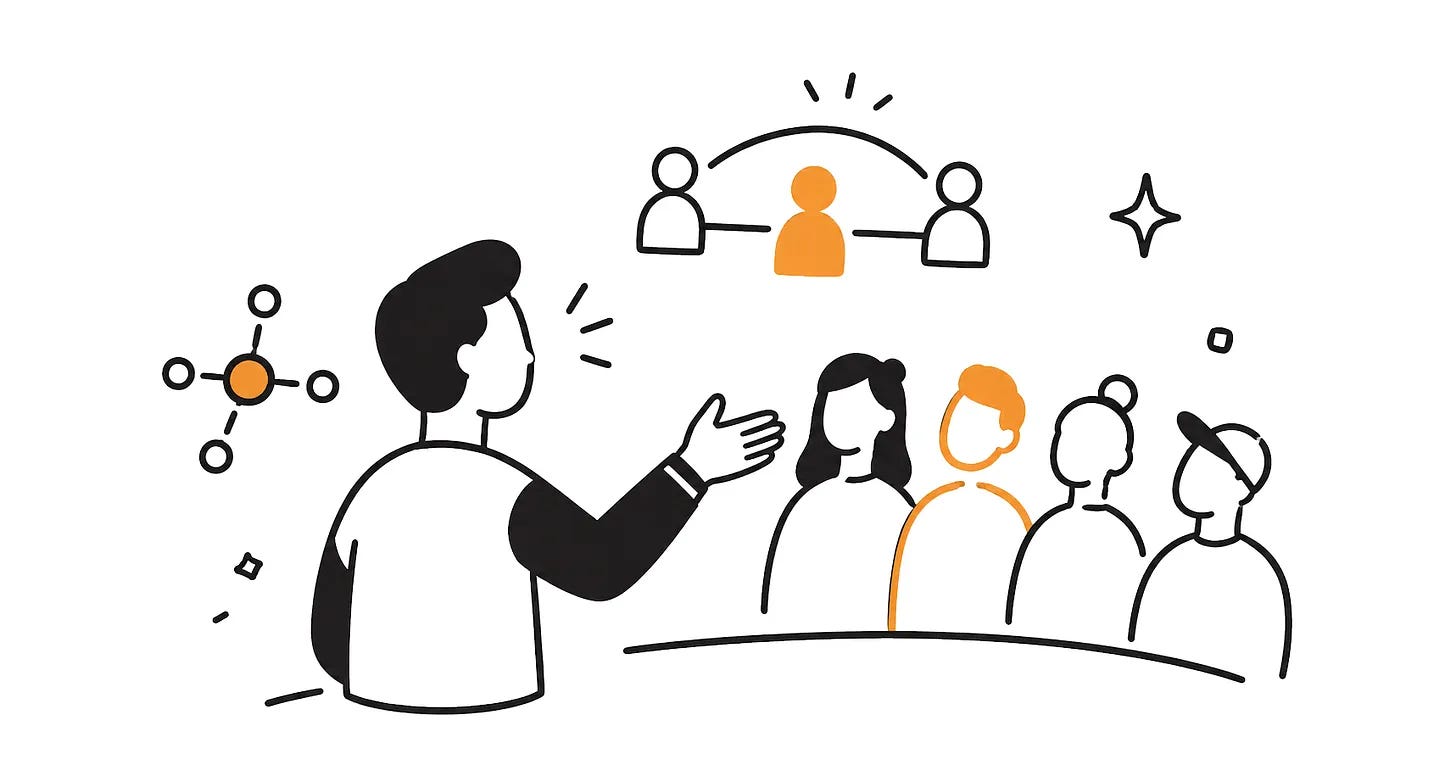
Here’s the thing that fascinates me most: the desire to get together had been there the whole time. For years. All that was missing was someone to say “Saturday at five, in the garden.” That’s all we did. We created the space, and people took care of the rest themselves.
What does this have to do with marketing?
When you’re trying to make a name for yourself in any field, you keep hitting the same wall - nobody knows you. You have no reputation, no references, no audience. You try to get noticed and it’s painfully slow.
But there’s a shortcut: don’t try to get into the community - create one yourself. Be the person who calls people in your field together and connects them.
It works thanks to one simple principle - the demand for meeting up is always much bigger than the supply. Almost everyone is happy to attend, almost nobody wants to organize. And that’s exactly why the person who steps up becomes instantly visible. The newcomer nobody knows turns into “the one who brought us all together.” You don’t have to be the biggest expert in the room. It’s enough to be the one who opened the room. And it’s no trick - you’re doing useful work that others appreciate. It just rarely occurs to anyone that literally anybody can do it. Including you.
I took that neighborhood barbecue lesson into business myself. Together with a friend, I organize Handshake business breakfasts in my town. They started exactly the same way - we were missing a space for informal, non-commercial meetups of freelancers and business owners, so we created one. No lectures, no sales pitches, just people from the field sharing experience over a good breakfast. And it works exactly like the barbecue did.
Who has already pulled this off?
Sara Horowitz started bringing American freelancers together long before freelancing was cool. Her Freelancers Union grew into a community of hundreds of thousands of members, and Sara became the voice of independent workers in the US - she even wrote The Freelancer’s Bible.
Online Geniuses started as a simple group chat where David Markovich connected a few marketers. Today it’s one of the largest marketing communities in the world, with tens of thousands of members - and David is the guy who knows everyone in the industry.
Rob Walling felt that big startup conferences had nothing to offer bootstrapped founders, so in 2011 he co-created his own event, MicroConf. It became the home base of the indie SaaS world and made Rob one of the best-known names in bootstrapping.
Tina Roth Eisenberg started hosting morning meetups for creatives in New York in 2008 - coffee, breakfast, a short talk, free entry. Her CreativeMornings now run in hundreds of cities around the world.
Notice that none of them started as “the biggest expert.” They started as people who created a space that was missing.
It works for brands and products too
Maybe you’re thinking: I’m not building a personal brand - I’m behind an e-shop, a product, or a service. The principle is the same, you’re just playing one level up:
Organize an event for your industry. Behind many big conferences you’ll find the tools and companies from the field themselves - like HubSpot and its INBOUND conference. Whoever creates the event stands on stage next to the top names in the industry, and nobody asks whether they belong there.
Rate and recommend. Whoever does the judging must know their stuff - otherwise they couldn’t judge, right? Review platforms like G2 hand out annual software awards and position themselves as the referee of the whole industry. And my favorite example is over a hundred years old: tire manufacturer Michelin started publishing a guide with restaurant tips in 1900 to get people to drive more. Today, the Michelin star is the biggest culinary authority in the world.
Build a community around your product. Harley-Davidson founded the Harley Owners Group, and a motorcycle manufacturer became the keeper of a huge community for which the brand is part of their identity. When you bring together people who share the same passion, you suddenly have a direct line to your target audience.
Join forces in your region. Running a guesthouse? Start an association promoting local tourism. You’ll help everyone, put the region on the map - and naturally place yourself among the recommended spots. The same works for restaurants, winemakers, and craftspeople.
Every time, it’s the same story as the barbecue behind our building: you create a space that was missing, you serve others - and authority arrives as a side effect.
How to start?
You don’t have to launch a festival right away. Host a breakfast for five people from your field at a café in your town. Start a group or a Discord around the topic you’re working on. Organize a customer meetup or a workshop for local business owners. Connect people who should know each other - “hey, you’re dealing with this, and he’s great at exactly that.”
And most importantly, stick with it. Your first event might be small, but organizing work compounds - every meetup brings new relationships, referrals, and gradually a name you didn’t have at the start. A one-off event is nice, regularity builds a position. Every example above stands on years of repetition.
If this topic caught your attention, I recommend the essay If You Build It, They Will Come by Ben Landau-Taylor. He beautifully describes how communities don’t grow on their own like blueberries on a bush - there’s always someone behind them who took on the organizing. And those are exactly the people who naturally become the leaders of their communities.
P.S. There’s one more reason nobody talks about much. A community won’t just help you build a name - it will also help you avoid burnout. We spend whole days sitting alone in front of a screen, feeling constant pressure not to miss anything, because AI changes every week. The best remedy I’ve found so far? Sitting down with people who deal with the same things. Talking, venting, getting inspired. Just realizing you’re not alone in this is a huge relief. Making new friends as an adult isn’t easy, and we each live in our own bubble - I know two reliable ways out: sports, and meetups like these. And the second one comes with a bonus. You can be the person who creates them for others.
So, will you give it a try? Feel free to start by calling your own “neighborhood get-together” - in a garden, or on the internet. I’d love to hear how it went, so drop me a line afterwards.
Have a great day! ☀️
See you in the next article,
Jan Barborik
P.S.: If you enjoyed this article, forward it to a friend.
If you're that sexy friend, subscribe here.
P.P.S: Enjoying the content? Support the project! Help me keep creating practical marketing content by buying me a coffee. Every cup fuels more articles, tips, and resources for fellow entrepreneurs like you!