


Hey marketer! 👋🏻
Today’s headline may have caught you a little off guard. Don’t worry, there’s nothing spicy coming. But I want to show you an interesting paradox I’ve run into in my work.
Some industries are completely legal. They have customers, pay taxes and run like any other business. Yet paid advertising is out of their reach. The rules of ad platforms like Google and Meta are so strict for them that a campaign either gets rejected right away or is blocked after a few days. This includes adult e-shops and erotic massage parlors, and often shooting ranges, weapons dealers, some dietary supplements and alcohol too.
So what do these businesses do? They have to find another way. And this is where it gets interesting for you as well.
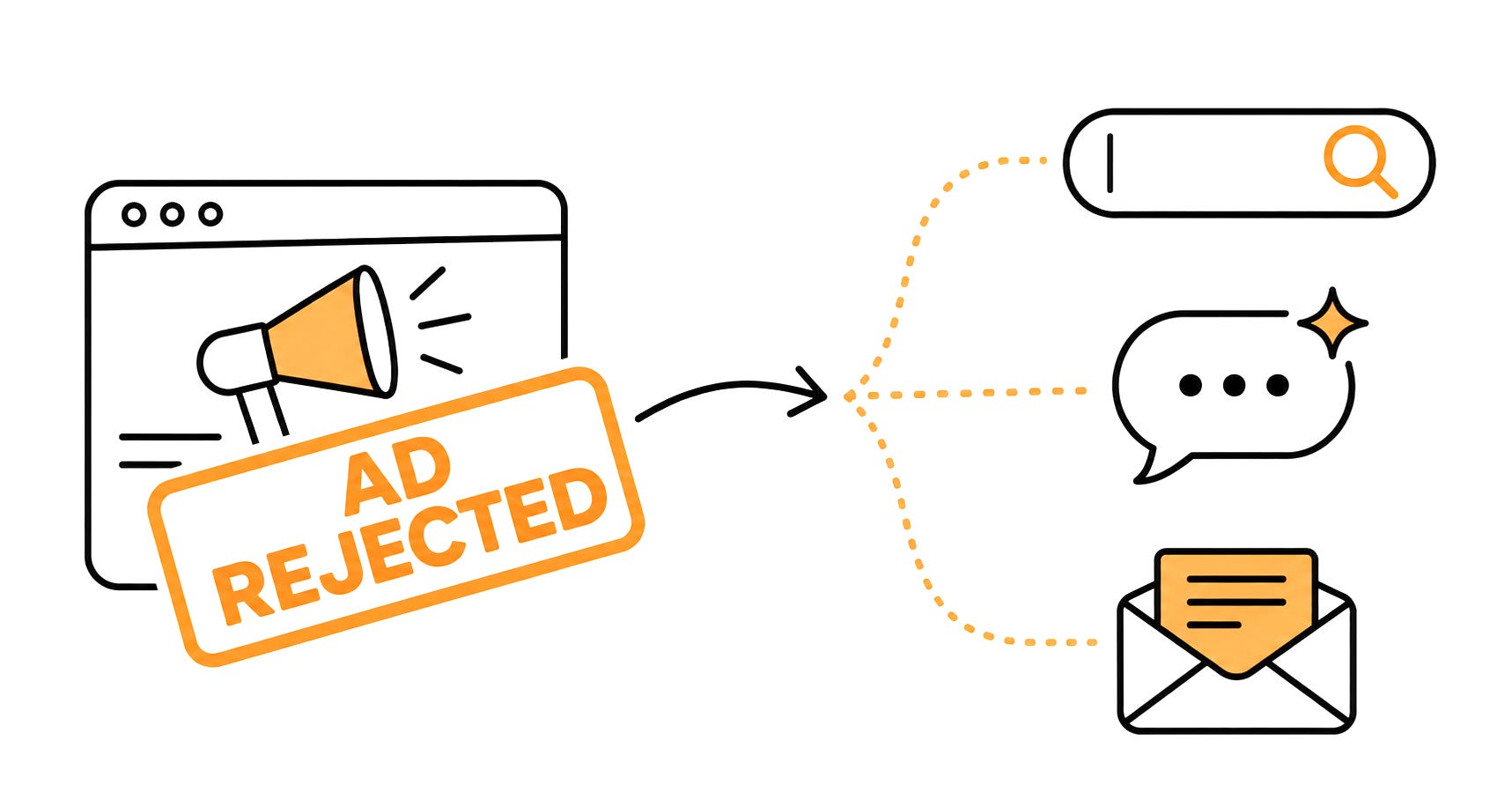
When you can’t run ads, you have to think differently
If you can’t buy attention, you have to earn it. That’s why businesses in these industries usually do three things much better than everyone else:
They know their target audience inside out. They can’t shoot blindly and hope the ads find the right people. They need to know exactly who their customer is, what they’re looking for, what they’re afraid of and what words they use to describe their problem.
They’re easy to find. If you can’t reach people through ads, they have to find you on their own. That’s why these businesses invest in a quality website, in SEO (search engine optimization) and more and more in GEO, which means getting recommended by AI tools like ChatGPT or Gemini.
They take care of the customers they already have. Every new customer is expensive for them, so they try to keep each one as long as possible. Newsletters, loyalty programs, a personal touch, after-sales care, affiliate programs. The goal is for customers to come back and recommend them to others.
You don’t have this problem. But try to imagine it…
Your business most likely doesn’t fall into any of these categories. You can run ads whenever you like. But imagine for a moment that you couldn’t. How would you win customers then?
This thought experiment makes sense for three reasons:
1. Advertising keeps getting more expensive. According to long-term benchmarks from WordStream, the average click in Google Ads now costs $5.42. Ten years ago it was $2.32, so the price has more than doubled. Prices calmed down a bit last year, but the year before they jumped by almost 13%. If you rely only on ads, you pay more every year for the same result. You probably know this from your own experience.
2. The way people search is changing. According to a SparkToro study, about 60% of Google searches in the US ended without a click to a website in 2024. By early 2026, it was 68%. More and more often, people get their answer right in the search engine or in an AI tool. AI Overviews, the AI-generated summaries above the search results, play a big part in this. In the sample of queries tracked by DataForSEO, they appeared in just under 6% of results two years ago. Today it’s 61%.
Organic search still brings far more visits than AI assistants, about 39 times more according to one study. But traffic from AI tools has grown almost tenfold over the last 19 months. And these visitors are ready to buy: people who came to US e-shops from ChatGPT made a purchase 7% of the time, while visitors from Google converted at 5%.
Most of this data comes from the US. But the American market is usually a step ahead in online marketing, and similar trends have reached other markets many times with a small delay. If you start thinking about it early, you’ll have a head start.
3. It’s an easier path when you do marketing on your own. Setting up a high-performing, efficient ad campaign takes a lot of experience and experimenting with real money. Thinking about your content, your customer and how to keep them is something anyone can do. And along the way, you’ll get your whole marketing strategy clear in your head.
How to apply this to your business or project
Describe your customer. Write down who exactly they are, what bothers them and what they type into Google or ChatGPT when looking for a solution (see the Value Proposition Canvas). Everything else builds on this.
Answer the questions people actually ask. On your website, on your blog, in your FAQ. The more precise and clear your answers, the more likely Google and AI will find you.
Make sure others talk about you too. According to research by Muck Rack, about 84% of the links AI assistants cite come from external sources: articles, reviews, interviews and recommendations. Brands’ own and paid content makes up only part of it. That’s why reviews, media mentions, podcast interviews and collaborations with other websites carry more weight than ever.
Collect contacts and work with them. Every customer who has given you their email is valuable. Send them useful tips, stay on their radar, offer them something extra. A repeat purchase from a happy customer is the cheapest sale you can make.
Treat ads as a booster. Once you have these basics in place, you can run ads in short bursts, for example before a busy season or when launching something new. Or keep them running on a smaller scale in the background. But you’ll bring in a large share of your customers yourself, and you won’t depend on ads.
The bottom line
This is a topic I keep coming back to with my clients lately. The main task is to build their expert reputation and authority so that Google and AI tools recommend them as often as possible. I covered how to show and prove that expertise on your website in my article on E-E-A-T and why both customers and Google want to see your expertise.
You need to know your target audience, create useful content, collect reviews and mentions from others and take care of the customers you already have. And it’s important to connect all of these together.
It’s a long game, and it takes a lot of quality, well-thought-out and relevant content. Plus ongoing analysis. If you stick with it, you’ll build a lasting source of new customers.
So, what would your marketing look like if someone banned you from paid ads?
Thanks for being here with me. I wish you beautiful autumn days, and I’m looking forward to seeing you in the next article! 🍂
See you in the next article,
Jan Barborik
P.S.: If you enjoyed this article, forward it to a friend.
If you're that sexy friend, subscribe here.
P.P.S: Enjoying the content? Support the project! Help me keep creating practical marketing content by buying me a coffee. Every cup fuels more articles, tips, and resources for fellow entrepreneurs like you!
Data sources: WordStream / LocaliQ Google Ads Benchmarks 2026, SparkToro (zero-click studies 2024 and 2026), DataForSEO Search Insider 2026, SEO Works (September 2026), Similarweb Gen AI Landscape 2025, Muck Rack (May 2026).